

What do you need to know?
Your bite‑size guide to the new EPC and MEES rules, including four smart strategies that landlords can’t afford to ignore. Are you prepared for these changes?
2025 is a busy year for landlords in the UK. Not only are they having to juggle the usual challenges thrown at them, including tenant turnovers and the eternal hunt for a good plumber, but there is also a growing number of regulatory pressures. The latest changes, related to the energy efficiency of rental properties, are now just around the corner and it’s critical that all landlords are prepared for this.
At Green Home Guide, our aim is to help you navigate these changes more effectively. We’ve pulled together an overview of the changes to allow landlords like you to get ahead of the game.
What’s changing?
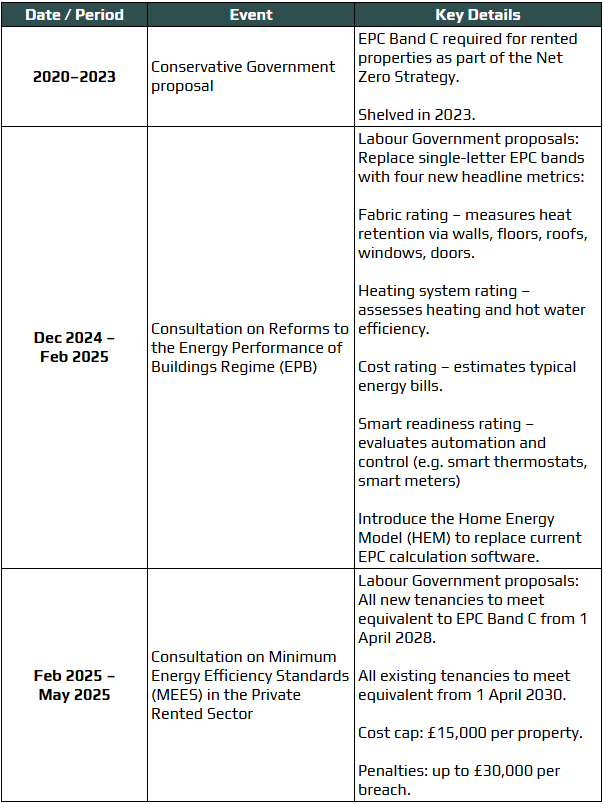
After years of back-and-forth, the UK is finally on the move with energy efficiency reforms for rentals. Under the Energy Performance of Building Regime (EPB), the single-letter EPC bands we’ve all learned to love (or loathe) are set to be replaced with four new metrics: a Fabric rating for how well your property holds heat, a Heating system rating for boiler and hot water efficiency, a Cost rating for estimated energy bills, and a Smart readiness rating for automation and control technology. A new Home Energy Model will power these assessments.
Meanwhile, the Labour Government has revived the previously shelved Minimum Energy Efficiency Standards (MEES), proposing that all new tenancies hit the equivalent of EPC Band C from April 2028, and all existing tenancies by April 2030, with penalties of up to £30,000 for non-compliance.
What does this mean for landlords?
These regulatory changes will be a big shift in how rental properties are assessed and regulated for energy efficiency.
What is clear is that rental properties will soon need to meet the equivalent of EPC Band C, however what isn’t clear is what “equivalent to EPC Band C” will mean given that the EPC single-letter band is about to be replaced by four new headline metrics.
It’s like being told to train for a football match, only to find out just before kick-off that the rules have changed and you’re now playing rugby. The goalposts haven’t just moved; they’ve changed shape entirely.
Why is the EPB being overhauled?
Large-scale manufacturing plants and cow flatulence often hit the headlines for their impact on the planet. However, in the UK our domestic buildings emit broadly the same amount of greenhouse gases as the agricultural and manufacturing sectors combined. The Government is therefore giving the EPB and MEES a full service and MOT.
What are the key milestones in reforms to date?
The path to where we are today has been long, and over the last 5 years we have seen multiple reviews, delays, and policy pivots (who’d have thought it?).
At Green Home Guide, we poured over hundreds of pages of government consultations, so we have a good feel on what is likely to change. Here’s a brief history and the current state of play:
What are the next steps for implementation?
By the end of 2025 or early 2026, we expect that the UK Government will publish responses to both consultations (one on changes to the EPB regime, and the other on minimum energy efficiency standards for rental properties).
In 2026, we expect both pieces of legislation to become law. The groundwork has already been laid:
- For EPB reforms:
- Government can already make changes to the EPB as it has the powers to do so from the Energy Act that was approved in 2023.
- For minimum standards for rented properties:
- This was part of Labour’s manifesto pledge, and the policy is aligned with the Labour government’s broader fuel poverty and net-zero strategies.
How can Green Home Guide help?
At Green Home Guide, our whole purpose is to simplify this complexity for you. We have developed 4 simple strategies that landlords could take now in preparation for this upcoming regulation change:
- Check if your EPC has quietly improved
- Invest now to bank EPC Band C before the rules change
- Use grants before they vanish to climb the EPC ladder
- Sit tight until the dust settles on EPC and MEES rules
We have looked closely at pros and cons of each strategy in separate blog posts, empowering you to make an informed choice on which strategy you select.
Want personalised advice?
Sign up to our waitlist and be the first to know when we at Green Home Guide launch our tool to develop tailored energy efficiency plans for your properties. Our system doesn’t just spit out generic tips, it analyses your property’s unique EPC data, age, construction type, heating system, and more.
We’ll show you the most cost-effective route to compliance, highlight grant funding you could still claim, and flag upgrades that may become mandatory so you can plan ahead. Think of it as your property’s personal coach for navigating the changing energy efficiency regulation!
References
- Reforms to the Energy Performance of Buildings consultation (Dec 2024–Feb 2025): https://www.gov.uk/government/consultations/reforms-to-the-energy-performance-of-buildings-regime
- MEES consultation for private rented sector (Feb 7–May 2, 2025): https://www.gov.uk/government/consultations/improving-the-energy-performance-of-privately-rented-homes-2025-update/improving-the-energy-performance-of-privately-rented-homes-consultation-document-html
- Energy Act 2023:https://www.legislation.gov.uk/ukpga/2023/52/2024-10-01/data.html